SAFOZi

WORDPRESS HA

WORDPRESS HA

Simplify your code deployment and scale your environment

wordpress

WordPress is a content management system (CMS) that allows the creation and dynamic management of websites, including business sites, blogs, forums, and eCommerce platforms.

Bandwidth Protection

99.90% Uptime SLA
Data center: EODC, Enfidha

WORDPRESS HA

Hosting WORDPRESS HA Starting

9 DT excl. tax / month

Benefits

  • One-Click Installation
  • Wide Selection of Free Themes
  • Extensive Plugin Library (e.g., Google Analytics, All in One SEO)

Deploy your applications on a PaaS hosted
in a Tunisian data center certified to ISO
27001 and PCI DSS standards.

Deploy your solutions on a PaaS
compliant with Tunisian laws and achieve
savings of 40–50% compared to
AWS and Microsoft Azure.

FAQ

Is WordPress a CMS platform?

Yes. WordPress is a popular open-source content management system (CMS).
Originally known for personal blogs, it is now used to build a wide range of websites, including business sites, professional publications, and eCommerce platforms.

  1. Define Your Website Goals
  2. Choose a Domain Name
  3. Purchase Web Hosting
  4. Install WordPress
  5. Select a Theme
  6. Install Essential Plugins
  7. Configure Settings & Create Pages
  8. Publish Your Website

PRESTASHOP

PRESTASHOP

Simplify your code deployment and scale your environment

PrestaShop is an eCommerce platform that allows you to create and manage online stores.

Bandwidth Protection

99.90% Uptime SLA
Data center: EODC, Enfidha

PrestaShop

Hosting PRESTASHOP Starting from

9 DT excl. tax / month

Benefits

  • Open-Source Platform
  • Beginner-Friendly
  • Powerful and Reliable Platform

Deploy your applications on a PaaS hosted
in a Tunisian data center certified to ISO
27001 and PCI DSS standards.

Deploy your solutions on a PaaS
compliant with Tunisian laws and achieve
savings of 40–50% compared to
AWS and Microsoft Azure.

FAQ

What is PrestaShop used for?

PrestaShop is an online eCommerce platform that allows users to create and manage online stores.
It enables businesses to sell products and services online by building websites, adding features, and processing payments.

It depends on your needs. Shopify is the best choice if you’re looking for an easy-to-use, fully managed platform with no technical requirements.
PrestaShop is more suitable if you need greater customization and flexibility, especially for international selling.

Yes. PrestaShop is a powerful eCommerce platform, especially suitable for businesses that require customization and flexibility.
It offers a wide range of features and modules, making it a strong choice for online stores.

6th most popular open-source platform in the United States. 7th most popular open-source platform worldwide. 12th most popular open-source platform among the Top 1 million websites. 18th most popular open-source platform among the Top 10,000 websites

Yes. PrestaShop is easy to use and offers a user-friendly interface that allows users to manage their online store with ease.
Hiring a PrestaShop developer can further unlock advanced customization and eCommerce capabilities.

MAGENTO HA

MAGENTO HA

Simplify your code deployment and scale your environment

Magento is an open-source eCommerce platform used to build and manage online stores of all sizes.

Bandwidth Protection

99.90% Uptime SLA
Data center: EODC, Enfidha

MAGENTO HA

Hosting MAGENTO HA Starting from

9 DT excl. tax / month

Benefits

  • Easy to Use
  • Advanced SEO Features
  • Multi-Store Management from a Single Dashboard
  • Built-in Marketing Tools
  • Analytics & Reporting

Deploy your applications on a PaaS hosted
in a Tunisian data center certified to ISO
27001 and PCI DSS standards.

Deploy your solutions on a PaaS
compliant with Tunisian laws and achieve
savings of 40–50% compared to
AWS and Microsoft Azure.

FAQ

What is Magento used for?

Magento is an eCommerce platform owned by Adobe, designed to build and manage online stores.
It provides a wide range of features that help businesses engage customers and sell products effectively.

No. The main difference is that Shopify is a hosted platform, while Magento is self-hosted.
With Shopify, hosting is fully managed and included in the monthly plan, whereas Magento requires you to manage your own hosting environment.

It depends on your needs. Magento offers more built-in advanced features, while Shopify often requires additional apps to extend functionality.
Both platforms support unlimited products, but they differ in flexibility and ease of use.

Magento includes both front-end and back-end components.
It provides tools for managing the backend (products, orders, customers) as well as customizing the frontend (themes, UI, and user experience).

JOOMLA

JOOMLA

Simplify your code deployment and scale your environment

Joomla is a content management system (CMS) that allows you to create and manage websites

Bandwidth Protection

99.90% Uptime SLA
Data center: EODC, Enfidha

JOOMLA

Hosting JOOMLA Starting from

9 DT excl. tax / month

Benefits

• Open-source platform

• Easy to modify

• Intuitive management interface

• Large number of extensions

Deploy your applications on a PaaS hosted
in a Tunisian data center certified to ISO
27001 and PCI DSS standards.

Deploy your solutions on a PaaS
compliant with Tunisian laws and achieve
savings of 40–50% compared to
AWS and Microsoft Azure.

FAQ

What are the advantages of Joomla?

Joomla is an open-source content management system (CMS) used to publish web content.
Like many CMS platforms, it allows you to build websites without needing HTML or CSS, making it accessible and cost-effective for businesses and non-profit organizations.

  • A flexible system, easy to extend and customize.
  • Optimized for search engines out of the box 
  • Free and open-source software 
  • Security-focused development with proven results 
  • Scales naturally with your evolving needs 
  • Build powerful PHP applications 

Joomla is an open-source content management system (CMS) used to create and manage web content.
It is written in PHP and uses a MySQL database for data storage, following object-oriented programming principles.

Joomla can be used to create:

  • Corporate websites and portals, intranets, and extranets
  • Small business websites
  • Online magazines, newspapers, and publications
  • eCommerce platforms and online booking systems
  • Government, non-profit, and organizational websites
  • Community, educational, and religious portals

Redis

REDIS

Deploy, Scale, and Accelerate Your Data with In-Memory Performance

Redis is an open-source, in-memory data structure store used as a database, cache, and message broker.
It delivers ultra-fast performance for real-time applications by storing data directly in memory.

Bandwidth Protection

99.90% Uptime SLA
Data center: EODC, Enfidha

REDIS

Hosting REDIS Starting from

9 DT excl. tax / month

Deploy your applications on a PaaS hosted
in a Tunisian data center certified to ISO
27001 and PCI DSS standards.

Deploy your solutions on a PaaS
compliant with Tunisian laws and achieve
savings of 40–50% compared to
AWS and Microsoft Azure.

FAQ

Does Redis provide high availability?

Yes. Redis ensures high availability by replicating a primary node to one or more replica nodes.
Changes made on the primary node are asynchronously replicated to the replicas, ensuring data redundancy and improved resilience.

Yes. Redis ensures high availability by replicating a primary node to one or more replica nodes.
Changes made on the primary node are asynchronously replicated to the replicas, ensuring data redundancy and improved resilience.

A standalone Redis server is easy to configure and use, but it is not resilient to node failure.
Regardless of whether you use RDB or AOF persistence, if the node becomes unavailable, your service is affected.

It depends on the use case. Redis is generally faster than MongoDB when working with small datasets because it stores data in memory.
However, as data volume grows, MongoDB can handle large datasets more efficiently and maintain better performance at scale.

High availability ensures that your IT infrastructure continues to operate even if some components fail.
It is essential for critical systems, where downtime can negatively impact the business, leading to additional costs or financial losses.

POSTGRESQL HA

PostgreSQL HA

Simplify your code deployment and scale your environment

PostgreSQL is a powerful and robust relational database management system (RDBMS) based on a client-server architecture.

Bandwidth Protection

99.90% Uptime SLA
Data center: EODC, Enfidha

PostgreSQL HA

Hosting POSTGRESQL HA Starting from

9 DT excl. tax / month

Deploy your applications on a PaaS hosted
in a Tunisian data center certified to ISO
27001 and PCI DSS standards.

Deploy your solutions on a PaaS
compliant with Tunisian laws and achieve
savings of 40–50% compared to
AWS and Microsoft Azure.

FAQ

What is PostgreSQL used for?

PostgreSQL is a relational database management system (RDBMS) used to store, manage, and retrieve data for websites, eCommerce platforms, and applications.
It is known for its reliability, performance, and support for complex queries and advanced data types.

SQL is a language used to manage and query relational databases, while PostgreSQL is a relational database management system (RDBMS) that uses SQL to store and manage data.

PostgreSQL is a SQL database. It is a relational database management system (RDBMS) that uses SQL to store, manage, and query structured data.

PostgreSQL is popular due to its reliability, performance, and advanced features.
It supports complex queries, strong data integrity, and scalability, making it suitable for a wide range of applications.

Yes. PostgreSQL is designed to efficiently handle large volumes of data.
It offers advanced indexing, partitioning, and performance optimization features that make it suitable for data-intensive applications.

MONGODB HA

MONGODB HA

Simplify your code deployment and scale your environment

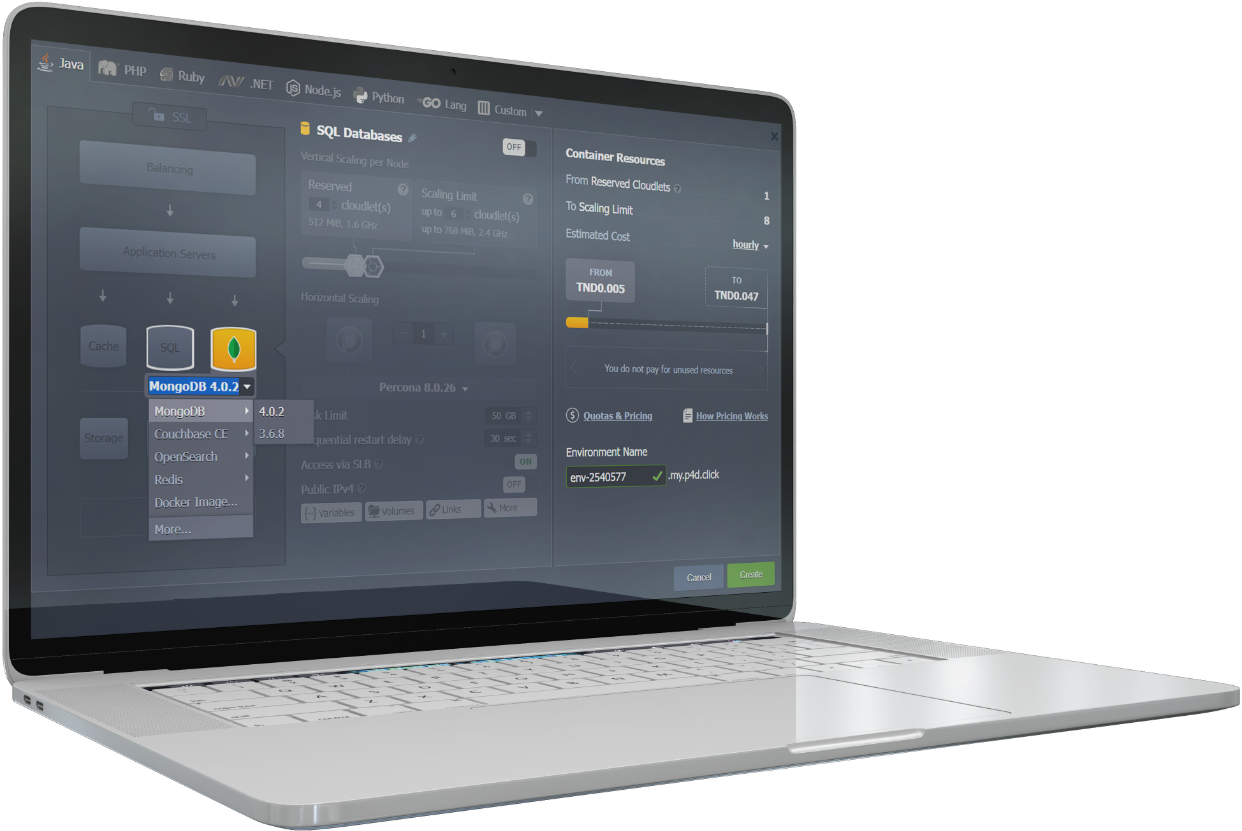
MongoDB is a NoSQL database management system designed to handle large volumes of unstructured and semi-structured data.

Bandwidth Protection

99.90% Uptime SLA
Data center: EODC, Enfidha

Mongodb HA

Hosting MONGODB HA Starting from

9 DT excl. tax / month

Deploy your applications on a PaaS hosted
in a Tunisian data center certified to ISO
27001 and PCI DSS standards.

Deploy your solutions on a PaaS
compliant with Tunisian laws and achieve
savings of 40–50% compared to
AWS and Microsoft Azure.

FAQ

Why Choose MongoDB?

MongoDB is known for its flexibility and scalability.
With its document-based model and JSON-like structure, it allows developers to build modern applications faster and handle large, evolving datasets with ease.

No. SQL databases are used to store structured data, while NoSQL databases like MongoDB are designed for unstructured or semi-structured data.
MongoDB stores data in a JSON-like format and does not support advanced joins in the same way as traditional SQL databases.

In some cases, yes. MySQL is a relational database (RDBMS), while MongoDB is a NoSQL document-oriented database.
MongoDB can be a good alternative when applications require flexibility, scalability, and rapidly evolving data models.

NoSQL databases like MongoDB are becoming increasingly popular due to their flexibility and scalability.
While traditional relational databases are still essential for many use cases, MongoDB plays a key role in modern data architectures.

Choosing between MongoDB and SQL depends on your application needs and data structure.

ASP.NET IIS8 HA

ASP.NET IIS8 HA

Simplify your code deployment and scale your environment

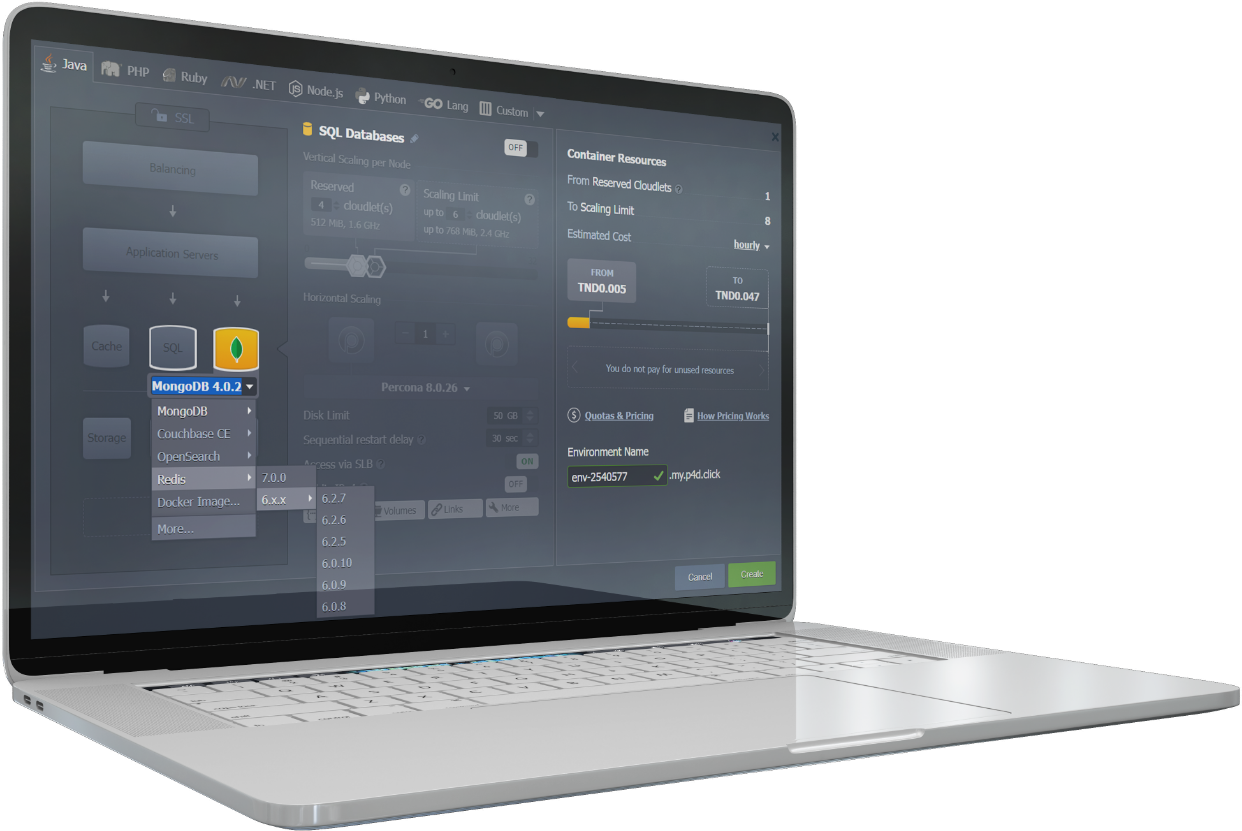
Set Up Your Environment in Seconds


Choose your application stack, define scaling limits, and assign a name.
In just a few seconds, your environment Java, PHP, Ruby, Node.js, or Python is ready to run in the cloud with SAS storage.

No Installation or Configuration Required


MySQL hosting automatically installs, configures, and connects your server instances with the selected application layer.
With high-availability (HA) hosting, simply deploy your MySQL application and you’re ready to go.

No API Coding Required


No need to write API code. Simply deploy your application to our cloud hosting platform and choose your application layer.

Bandwidth Protection

99.90% Uptime SLA
Data center: EODC, Enfidha

ASP.NET IIS8 HA

Hosting ASP.NET IIS8 HA Starting from

9 DT excl. tax / month

Deploy your applications on a PaaS hosted
in a Tunisian data center certified to ISO
27001 and PCI DSS standards.

Deploy your solutions on a PaaS
compliant with Tunisian laws and achieve
savings of 40–50% compared to
AWS and Microsoft Azure.

WEB SERVER & MYSQL HA

WEB SERVER & MYSQL HA

Simplify your code deployment and scale your environment

MySQL is a relational database management system (RDBMS) that allows you to manage databases efficiently, including handling large volumes of data.

Bandwidth Protection

99.90% Uptime SLA
Data center: EODC, Enfidha

WEB SERVER & MYSQL HA

Hosting WEB SERVER & MYSQL HA Starting from

9 DT excl. tax / month

Benefits

  • Load Balancing
  • Automation
  • Preconfigured Replication Options
  • High Availability

Deploy your applications on a PaaS hosted
in a Tunisian data center certified to ISO
27001 and PCI DSS standards.

Déployez vos solutions sur un PaaS
conforme aux lois tunisiennes et réalisez
des économies de 40 à 50% par rapport à
AWS et Microsoft Azure.

FAQ

Is MySQL a web server?

No. MySQL is a database server used to store and manage multiple databases for websites, eCommerce platforms, and applications.
There are two main versions: a free open-source edition and MySQL Enterprise, which includes additional plugins and extensions.

MySQL is a relational database management system (RDBMS) that can handle multiple users and databases.
It runs as a server and is commonly installed on web hosting environments such as WordPress.

Think of it as a digital filing system that organizes and stores all the data of your website.

MySQL failover is a process in which a standby server automatically takes over when the primary server fails.
In a failover setup, all servers typically execute the same events from a shared binary log, ensuring that switching the source of events does not affect the database structure or integrity provided the transition is handled correctly.

High Availability (HA) in MySQL refers to the system’s ability to remain operational and accessible even in the event of infrastructure failures.
It is typically achieved through replication, clustering, and failover mechanisms that ensure database availability within a cloud region.

GLASSFISH 3 HA

GLASSFISH HA

Simplify your code deployment and scale your environment

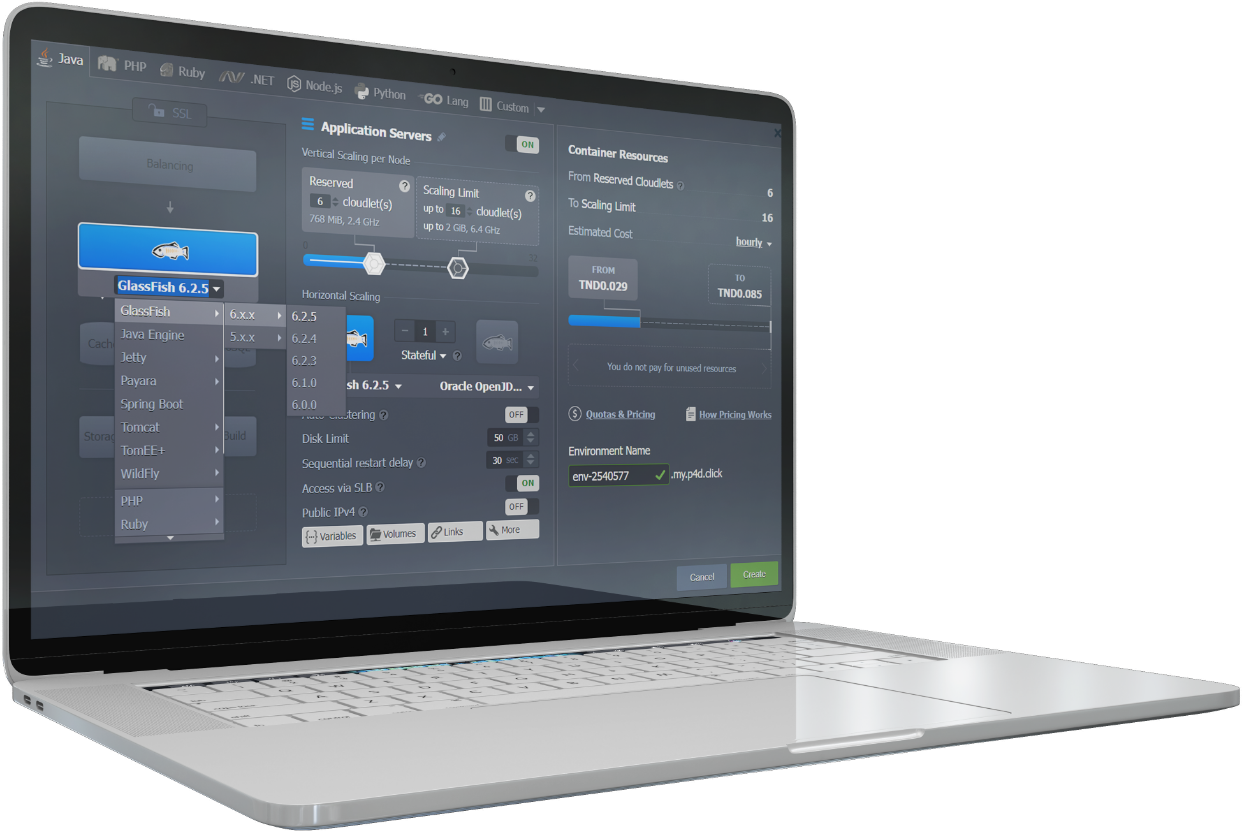
GlassFish Open Source Edition provides an application server for developing and deploying enterprise applications.

Bandwidth Protection

99.90% Uptime SLA
Data center: EODC, Enfidha

GlassFish 3 HA

Hosting GlassFish Starting from

9 DT excl. tax / month

Benefits

• Simplified Application Deployment

• Low Resource Consumption

• High Availability

• Easy Jakarta EE Application Hosting

Deploy your applications on a PaaS hosted
in a Tunisian data center certified to ISO
27001 and PCI DSS standards.

Deploy your solutions on a PaaS
compliant with Tunisian laws and achieve
savings of 40–50% compared to
AWS and Microsoft Azure.

FAQ

What is GlassFish used for?

GlassFish is an application server that can also function as a web server (HTTP server).
A web server handles HTTP requests, typically from browsers. As a servlet container, GlassFish can manage Java Servlets and JavaServer Pages (JSP).

The initial tasks involved in configuring GlassFish Server to connect to an enterprise information system (EIS) include creating a connector connection pool, defining connector resources, configuring resource adapters, and setting up security mappings.

These components allow GlassFish to manage connections, handle application requests, and ensure secure communication between your applications and backend systems.

GlassFish is a Java application server originally developed by Sun Microsystems.
It enables developers to build scalable enterprise applications and integrate additional services based on their needs.

The default port for GlassFish Server is 8080, while the administration console runs on port 4848.

To start GlassFish using the NetBeans IDE .Click on the Services tab. Expand the Servers node. Right-click on the GlassFish Server instance and select Start.