





GPU as a Service in the Mediterranean: Power, Sovereignty and the Compute Divide
Summary
The Mediterranean is one sea but three GPU markets. The northern shore has public AI factories and listed prices, the eastern shore is split by politics and export rules, and the southern shore has big plans with most capacity still to come.
- Supply: France, Italy, Spain and Greece hold the region’s clearest GPU capacity. Israel and Turkey have the strongest positions outside the EU. Several smaller countries show no public GPU service.
- Buyers: researchers get public compute, while enterprises and governments are the likeliest paying customers. Inference and fine-tuning fit most demand better than large-scale training.
- Investment: at $60,000 a GPU, a rental price of $2.11 to $2.99 an hour needs roughly 46% to 65% utilisation to repay the capital in five years, before running costs.
- Sovereignty: the EU is writing cloud sovereignty into law, but the chips remain imported. US export rules also treat countries on the same sea very differently.
- Outlook: most hosters and cloud providers should survive, but in fewer, more specialised forms. Pure GPU resellers carry the highest risk.
- Opportunity: the gap between the shores is the opening. Trusted providers can link northern capacity with southern and eastern demand, if the law allows it.
The Mediterranean has the cables, the capital and the demand to become a compute region, but those assets sit on different shores. The EU is moving up to €10B of public money into AI gigafactories, Israel has opened a national B200 cluster, and Egypt, Morocco and Tunisia have announced large campuses. Yet in several coastal states this review found no GPU service at all.
This article maps who supplies GPU as a service (GPUaaS) in all 21 Mediterranean countries, who buys it and why the business is hard. The core argument is that this is not one market. Power, law, capital and export rules change at each border, so a provider’s real competition depends on which shore it stands on.
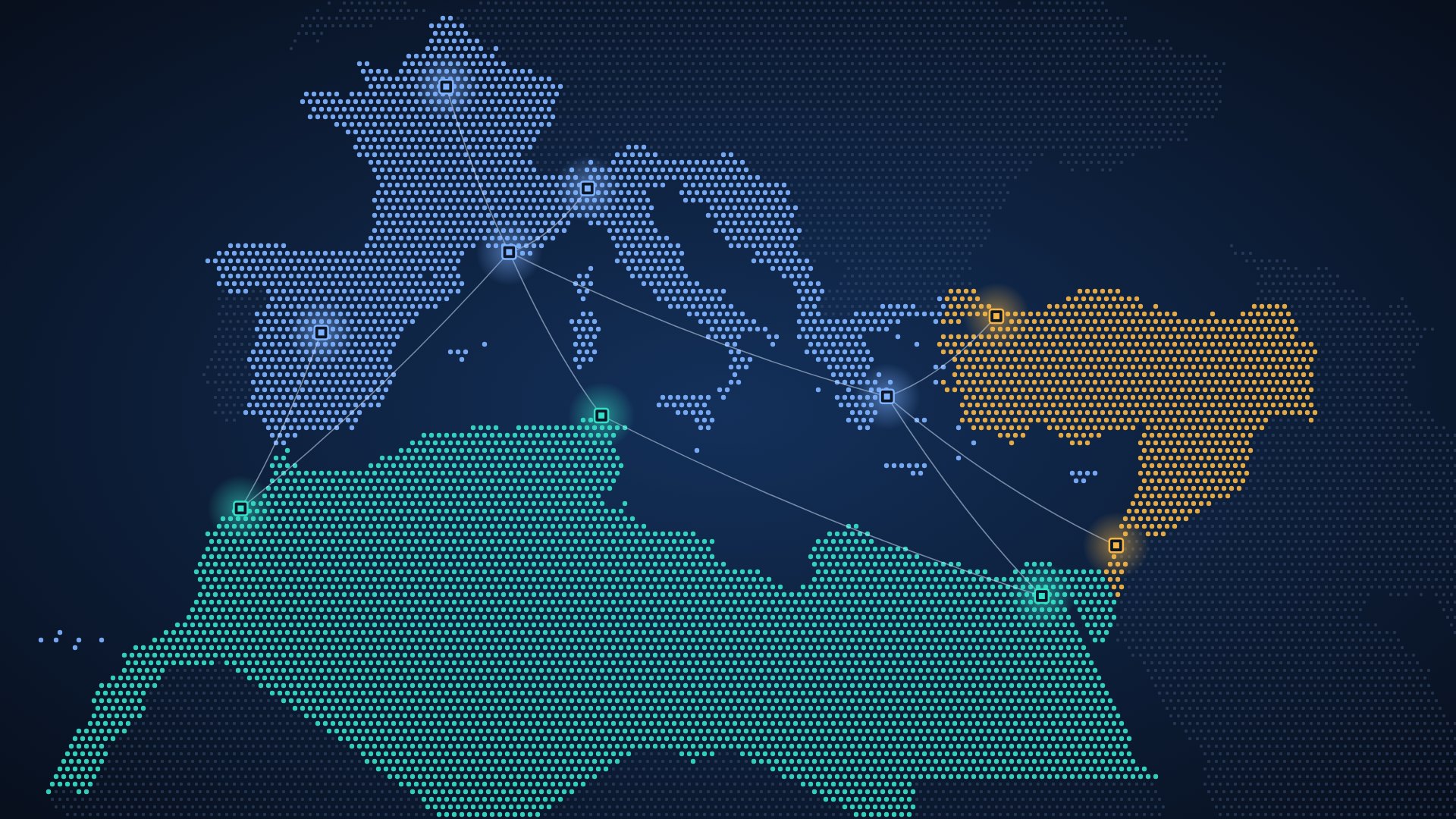
The Mediterranean at a glance: three shores, three economies
Compute in the region follows capital and power more than growth. Morocco grows fastest among the countries below, but France has the largest confirmed private GPU build.
| Shore | Countries | Growth signal | Compute position, November 2026 |
|---|---|---|---|
| North | Spain, France, Monaco, Italy, Slovenia, Croatia, Bosnia and Herzegovina, Montenegro, Albania, Greece, Malta, Cyprus | Spain 2.5%, Italy 0.8%, France 0.4%; eurozone 1.1% | Public AI factories, listed GPU prices, private campuses |
| East | Turkey, Syria, Lebanon, Israel | Türkiye 2.7% | Israel and Turkey active; Syria and Lebanon constrained |
| South | Egypt, Libya, Tunisia, Algeria, Morocco | Morocco 4.5% | Large plans, with most capacity due from 2027 |
Growth figures are IMF forecasts for 2026 from the October World Economic Outlook, which puts the world at 3.1%.
The numbers that matter most for a GPU provider:
- Connectivity: Marseille has 12 live subsea cable landings, and DC Byte counts 20 live and planned cable systems across its Mediterranean markets.
- Local capacity: Barcelona had 63 MW live and Marseille 58 MW in mid-2025. Madrid is expected to pass 1 GW by 2031.
- Grid: Spain’s 2025 to 2030 grid plan sets aside 3.8 GW for data centres, though delivery is uncertain.
- Cost of money: Türkiye’s policy rate is 36% after a cut in October, and Egypt’s deposit rate is 20%. A GPU priced in dollars is far harder to finance at those rates.
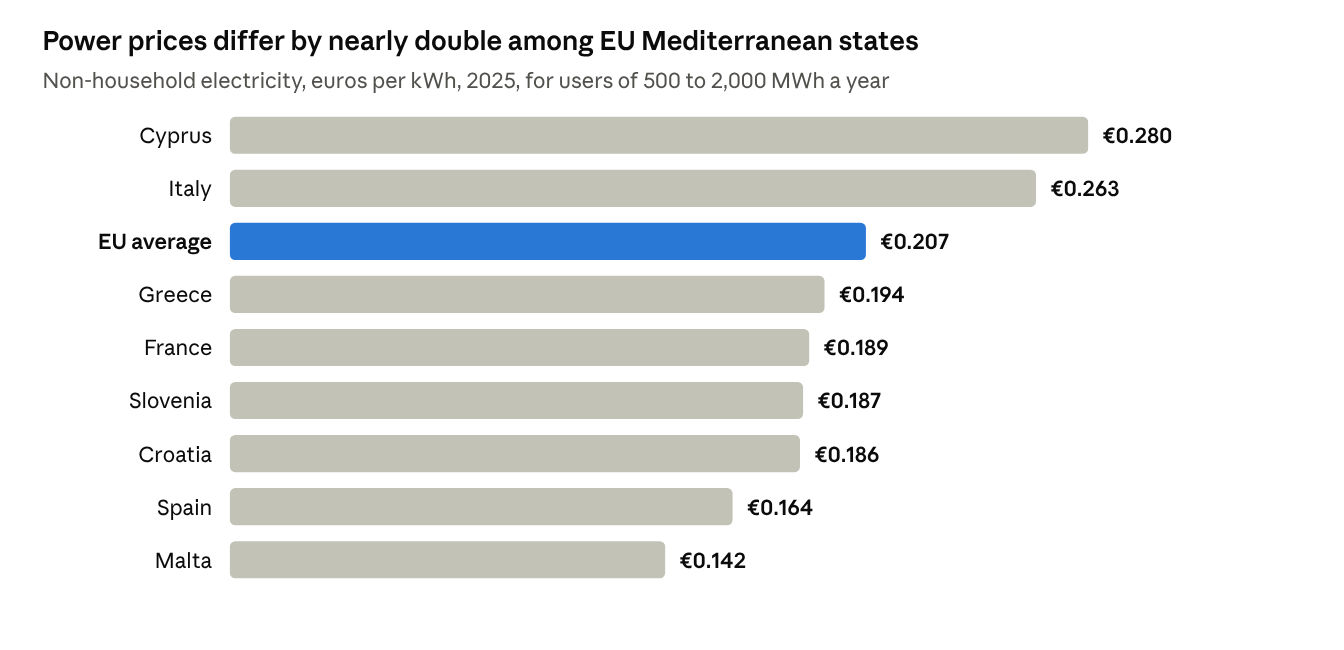
The power gap shapes the map. By my calculation, a constant 1 MW load at these listed rates would cost about €1.4M a year in Spain and €2.3M in Italy. Large operators negotiate lower prices, but the ranking still favours Iberia over Italy and the islands.
The provider landscape: public clusters, private clouds and paper campuses
No region-wide GPU count exists, so the picture below is built from individual disclosures. The table separates what runs today from what is planned, because the two are often reported together.
| Provider or system | Country | Hardware or scale | Status | Access |
|---|---|---|---|---|
| Mistral AI | France | 13,800 GB300 GPUs; 44 MW total; $830M debt | Funded; go-live date not stated | Enterprise commitments |
| OVHcloud | France | H100, A100, L40S; about $2.99 an hour for H100 | Available at Gravelines | Self-service |
| Scaleway | France | H100 SXM at about $2.87 to $3.31 an hour | Available in Paris and Warsaw | Self-service |
| Seeweb | Italy | H100 SXM at $2.11 and H200 at $2.90 an hour | Available | Pay per use |
| Fastweb + Vodafone | Italy | 248 H100 GPUs | Operating | Enterprise and sovereign AI |
| Leonardo, CINECA | Italy | 13,824 GPUs based on NVIDIA Ampere | Operating | Research and innovation |
| MareNostrum 5, BSC | Spain | Hopper and GB200 partitions | Operating | Research and innovation |
| Daedalus, GRNET | Greece | GH200; 85.69 petaflops; €58.9M | Inaugurated; full access expected in December | Calls for researchers, startups and SMEs |
| Vega, IZUM | Slovenia | 240 A100 GPUs | Operating | Research and innovation |
| Nebius national system | Israel | 1,000 B200 GPUs out of 4,000 deployed | Phase one live | Allocated by the Innovation Authority |
| GlassHouse | Turkey | H100, hosted in Turkey | Listed; no public price | Managed, pay as you go |
| OneCloud | Morocco | L40S nodes on Oracle infrastructure | Listed on provider’s website | Sales-led |
Global clouds cost several times more than local specialists. One vendor comparison puts H100 on AWS at about $12.30 an hour, Google at $12.49 and Azure at $14.00 in European regions. Those figures come from a competitor and are derived from 8-GPU instances, but the gap is too wide to ignore. Buyers pay it for platform breadth, not for the GPU alone.
The same comparison lists hyperscaler H100s in France but not in Italy, Spain or Greece. It also reports no direct on-demand B200 at the big three in the EU. Treat that as a mid-2026 snapshot and check live listings before relying on it.
Northern shore: public money meets private clouds
The northern shore is the region’s most developed market, but capacity is concentrated in four countries. The EU’s AI Factories network gives them public compute that smaller neighbours reach through partnerships.
| Country | Main development | Status |
|---|---|---|
| France | Mistral’s data centre near Paris; Alice Recoque at Bruyères-le-Châtel; OVHcloud and Scaleway | Strongest private market |
| Italy | Leonardo, Fastweb, Seeweb, Aruba; Scaleway has opened two zones | Broadest local offer |
| Spain | AI gigafactory bid at Móra la Nova and San Fernando de Henares; MareNostrum 5 | Bid awaiting EU selection |
| Greece | Daedalus at Lavrio, the core of the Pharos AI Factory | Inaugurated 19 October 2026 |
| Slovenia | Vega at Maribor | Operating, older GPUs |
| Croatia | Pantheon campus at Topusko, €12B | Construction planned for early 2027 |
| Cyprus, Malta | AI Factory antennas linked to Pharos | Access through Greece |
| Monaco, Albania, Montenegro, Bosnia and Herzegovina | No public GPU service found in this review | Likely served from abroad |
France leads on private capital. Mistral’s site takes its capacity to 44 MW, with 200 MW targeted across Europe by the end of 2027 and up to 1 GW by 2030. It is also the rare AMD story in this region: Alice Recoque will use MI430X GPUs.
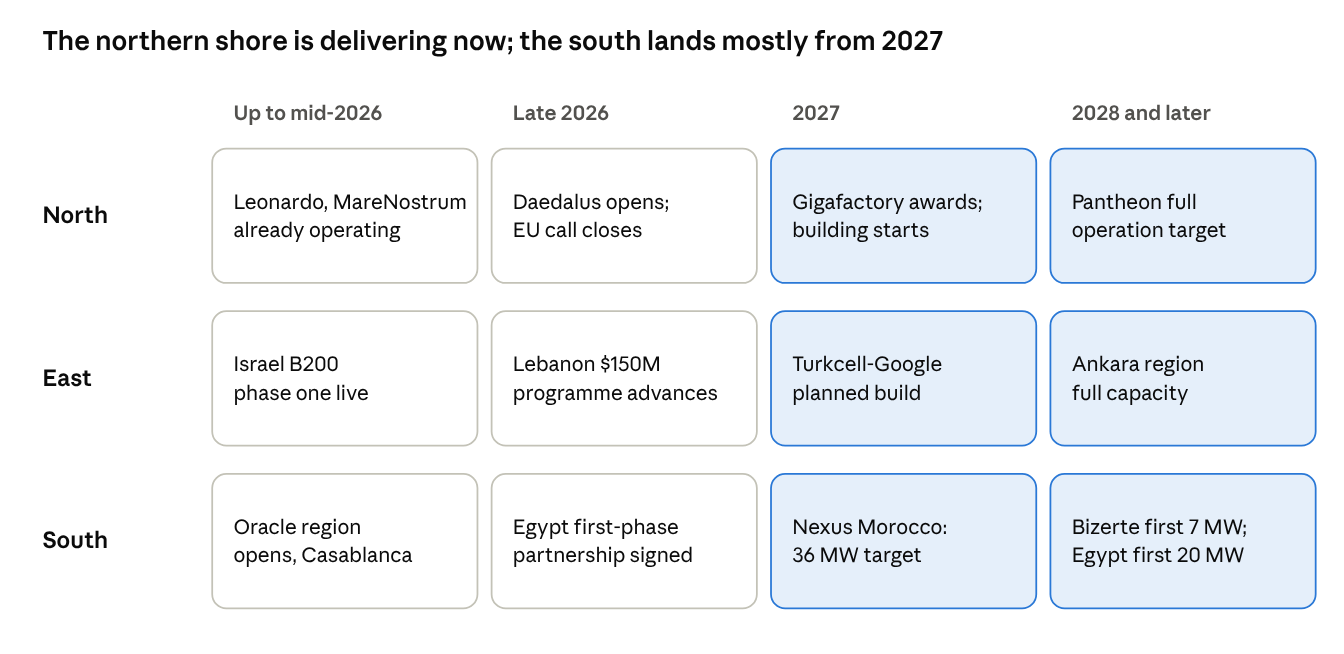
Spain is the region’s clearest state bet. Its gigafactory bid has €720M from the state holding SETT, with Telefónica, ACS and Santander as partners, and it could mobilise up to €5B. The EU call for up to seven gigafactories closes on 12 November 2026, with awards expected by early 2027. Up to €10B of public funding is meant to unlock at least €20B of private money.
Italy has the widest commercial choice. Seeweb lists an H100 at $2.11 an hour, and a June review of the market found offers from Aruba and Servereasy as well. High electricity prices remain its main weakness.
Greece shows what an AI factory can do for a smaller state. Daedalus ranks 31st on the TOP500 and will serve researchers, startups, SMEs and the public sector.
Croatia shows why a headline should be read with care. Pantheon’s backers hope for more than €50B in total, but the published detail names no chip vendor and no IT load, and full operation is not due until 2029.
Eastern shore: two active markets, two constrained ones
The eastern shore has the widest gap in the region. Israel and Turkey have real activity, while Syria and Lebanon are still rebuilding basic digital infrastructure.
Israel has the most concentrated national programme. Nebius won a tender in May 2025 and now runs 1,000 B200 GPUs for the national system. The Innovation Authority gives 70% of resources to high-tech companies and 30% to early-stage research groups, with usage periods of one to six months. This is a subsidised market-builder, not a commercial price list.
Turkey is building sovereign cloud around a domestic telecoms group. Turkcell and Google Cloud plan a cloud region of three data centres in Ankara, with full capacity planned for 2028, data kept in the country and encryption keys held by customers. Turkcell has about 50 MW today. Local providers already sell H100 access hosted in Turkey, but GlassHouse publishes no price. Reported national targets include $10B of private investment and 1 GW by 2030, which need official confirmation. A 36% policy rate is the main obstacle to any lira-funded GPU business.
Lebanon is at an earlier stage. A $150M World Bank-backed programme will finance digital infrastructure, including data centres. No public GPU service was found.
Syria faces legal limits as well as physical ones. The US has ended its comprehensive sanctions programme and eased licensing for civilian goods, and Congress has since repealed the Caesar Act. But most items on the US control list were still reported to need a licence, and Syria remained a designated state sponsor of terrorism in that guidance. No public GPU service was found.
Southern shore: big plans, later delivery
The southern shore is planning some of the region’s largest campuses, but most capacity arrives in 2027 or later. Each country is taking its own route.
| Country | Lead project | Planned scale | Timing |
|---|---|---|---|
| Egypt | Africa Data Centers Egypt with Vodafone, Elsewedy and Cassava | 200 MW and $1B target; first phase 20 MW | First phase over three years |
| Morocco | Nexus AI Factory; Oracle’s Casablanca region | 16 MW, then 20 MW more, for 36 MW by end-2027 | Earlier 40 MW date has slipped |
| Tunisia | SoleCrypt AI Campus, Bizerte | 40 MW; first 7 MW with 1,728 Rubin GPUs | Early 2028 |
| Algeria | ENSIA academic GPU system; Akid Lotfi centre in Oran | ENSIA reported to serve 52 universities | State-led |
| Libya | No public GPU service found | Connectivity first, including a network across more than 200 oil-sector sites | No date found |
Egypt shows that compute has become geopolitical. Huawei reportedly bid with 2,008 Ascend chips, while US officials were preparing a counteroffer. No award has been announced.
Morocco has the broadest set of options, with a hyperscaler region, a renewable-powered campus plan and local providers. Tunisia has talent and a strategic position: the Bizerte site sits close to the Medusa cable landing, which supports a role facing Europe.
The cross-sea link is the region’s most underused asset. Medusa, 2Africa and similar cables tie the southern shore directly to Marseille, Barcelona and Genoa. That makes a split model possible, with training or overflow in the north and regulated inference hosted at home.
Training, fine-tuning and inference: three different GPU businesses
GPUaaS is three products with different hardware, customers and economics. The north can sell all three, but most of the region should focus on inference and fine-tuning.
The global market points the same way. Gartner forecasts AI-optimised IaaS spending on inference at $23.3B in 2026, against $19B for training, and Deloitte forecasts that inference will take about two-thirds of AI compute in 2026.
| Workload | What it does | Typical hardware | Revenue pattern | Regional fit |
|---|---|---|---|---|
| Training | Builds a model from scratch | Many linked H100, H200, B200 or GB300 GPUs | Large, bursty projects | France, Spain and Israel, plus public AI factories |
| Fine-tuning | Adapts a model to local data or languages | One or a few L40S, RTX PRO 6000 or H100 GPUs | Short, repeated jobs | Strong in every language market |
| Inference | Runs a trained model for users | Memory-rich GPUs, often shared across workloads | Steady, recurring usage | Strongest where data must stay local |
Language gives this region a natural fine-tuning market. Arabic dialects, Turkish, Greek, Hebrew, Italian and Spanish all need adapted models, and the data is often sensitive. Mistral’s regional endpoints show the direction: customers now choose where inference runs.
GPU models running in the region
The region spans five chip generations. Public clusters still rely heavily on older GPUs, while the newest hardware is concentrated in a few funded projects.
| GPU | Status | Where | Best workload |
|---|---|---|---|
| A100 | In use | Leonardo, Italy; Vega, Slovenia; Seeweb | Research and inference |
| L40S | Available | OVHcloud, Seeweb, OneCloud | Inference and small fine-tuning jobs |
| H100 | Available | OVHcloud, Scaleway, Seeweb, Fastweb, GlassHouse | Fine-tuning and training |
| GH200 | In use | Daedalus, Greece | Research training and inference |
| H200 | Available | Seeweb | Large-model inference |
| B200 | In use | Nebius, Israel | Large-scale training |
| GB200 | In use or planned | MareNostrum 5, Spain; Nexus plan, Morocco | Large-scale training |
| GB300 | Funded | Mistral, France | Frontier-scale training |
| Rubin | Planned | Bizerte, Tunisia | Next-generation workloads |
| MI430X | Upcoming | Alice Recoque, France | Research at scale |
| Ascend 950, 910B | Proposed | Huawei’s reported Egypt bid | Training and inference |
Who makes the chips
No GPU in this article is designed or made in the Mediterranean region, even in France, Italy or Israel. NVIDIA dominates, with about 81% of AI data centre chip revenue in a widely cited estimate attributed to IDC. AMD estimates range from 5% to 13%.
For a provider, this is also a software and geopolitical choice. NVIDIA offers the deepest ecosystem. AMD now has a European flagship in Alice Recoque. Huawei offers a second supply route on the southern shore, but one that could complicate relations with US suppliers. The safest plan is to buy for contracted workloads and keep software portable.
The AI users: who actually buys compute
Demand is real on every shore, but public compute serves much of the research market. That leaves enterprises and governments as the most reliable paying customers.
| Buyer | Typical workload | What they value | Named examples |
|---|---|---|---|
| Researchers and universities | Model training and science | Free or subsidised access | EuroHPC users, Daedalus calls, ENSIA |
| Startups | Fine-tuning and inference | Low price, instant access | Israeli high-tech firms, Multiverse Computing |
| Enterprises | Customer service, search, industrial AI | Residency, contracts, support | Fastweb’s MIIA users; Mistral’s anchor enterprises |
| Governments | Public services, sovereign AI | Control, local hosting | Pharos, Israel, Egypt, Spain |
Public programmes are also market-makers. Israel’s scheme sets minimums of 16 B200 GPUs for industry and eight for academia, which trains local firms to use serious clusters. Daedalus opens its calls to startups and SMEs. A commercial provider must work out which of those users will graduate to paid capacity.
Enterprise commitments may become the stronger model. Mistral now turns multi-year enterprise commitments into access to infrastructure it builds, through what it calls European Compute Units. In effect, customers help finance the capacity before it exists.
Why GPUaaS is not an easy investment
GPUaaS is hard to underwrite on every shore, but for different reasons. The north faces price competition and public alternatives, the east faces capital and legal limits, and the south faces immature demand.
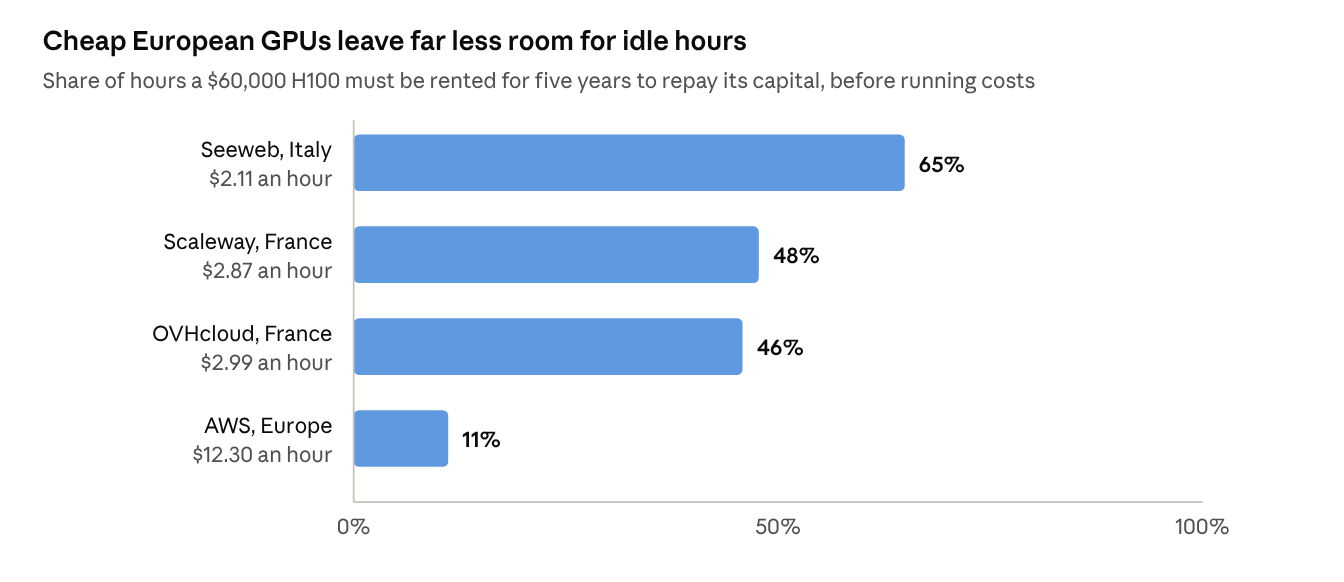
The arithmetic is unforgiving. At $60,000 per GPU and a five-year life, a $2.11 rental price needs 65% utilisation just to return the capital. At $2.99, it needs 46%. Hyperscalers need far less, but they also carry the costs of a full platform. Power, staff and interest push the real break-even higher, and cheaper hardware quotes would push it lower.
Market signals by shore
- North: listed prices are real, so margins can be compared and competed away. Public AI factories also reach startups and SMEs, which may narrow part of the commercial market.
- East: Israel’s subsidised programme sets expectations for local firms, while Turkey’s cost of money makes domestic financing very expensive.
- South: most training-class pricing remains private, and investors have little public data on demand.
Structural costs
- Power: listed 2025 business rates range from €0.142 per kWh in Malta to €0.280 in Cyprus.
- Grid: Spain’s 3.8 GW allocation shows the scale of demand, and its delivery remains uncertain.
- Currency: GPUs are priced in dollars, while buyers may earn euros, lira, shekels, dirhams or Egyptian pounds.
- Refresh: the region already runs five chip generations, so a new cluster can lose its pricing power within a few years.
- Tight real estate: Paris colocation vacancy was 8.0% in Q2 2026, so even mature markets are not simply waiting for tenants.
- Policy risk: the January 2025 AI diffusion rule has been rescinded, no replacement had been issued by September, and US officials have signalled further action.
Hosting equipment: sovereignty changes at each border
Local hosting gives data residency, not full sovereignty. In the Mediterranean, the meaning of sovereignty also changes with the legal system on each shore.
| Bloc | Main rule or pressure | What it means for GPU hosting |
|---|---|---|
| EU members | Proposed Cloud and AI Development Act | Public bodies could face four assurance levels, with EU providers as the general rule |
| Turkey | KVKK data protection law | Local hosting is a selling point for domestic providers |
| Israel | US-linked hardware supply | National compute is run by Nebius, an international operator |
| Southern shore | Sector and national rules, including Morocco’s decree 2-24-921 | Demand forms around regulated data |
The EU proposal is significant but unfinished. Published in June 2026, it aims to triple EU data centre capacity within five to seven years and would generally limit public bodies to EU-established cloud providers. Non-EU providers could qualify only under strict conditions. It still has to pass through Parliament and Council.
A European flag is not the same as a sovereign GPU service. OVHcloud holds SecNumCloud qualifications for some products, but its Public Cloud GPU instances were not qualified as of July 2026. Buyers should check the exact product, not only the company.
US export rules cut across the sea. Under the country groups in the now-rescinded AI diffusion framework, France, Italy and Spain sat in the most favoured tier, while Cyprus, Lebanon, Libya and Syria sat in the most restricted. That rule is gone, but the map shows how Washington may sort the region. A Cypriot project and an Italian one should not assume the same access. Providers need legal advice on current rules.
The US CLOUD Act adds another layer, because it reaches US providers wherever the data sits. Turkcell’s model tackles this by giving customers sole control of encryption keys, though the platform remains Google’s. Sovereignty often means choosing a dependency rather than removing one.
Before calling a hosted setup sovereign, buyers should ask:
- Who owns the GPUs, and can they be remotely restricted?
- Who holds root access and encryption keys?
- Which foreign laws reach the operator or its parent?
- Can the service run if vendor support or licences stop?
- Is the specific GPU product covered by the certification being claimed?
Will web hosters and cloud providers survive?
Most will survive, but fewer will stay independent, and many will sell something different by 2030. This section is my forecast, not a measured result.
| Provider type | Forecast to 2030 | Main reason | Best survival move |
|---|---|---|---|
| Commodity web hosters | Survive through consolidation | Price pressure and SaaS site builders | Sell to a regional group, or move into managed services |
| European sovereign clouds | Likely to grow | Procurement rules and customer caution | Win qualifications for GPU products, not only general cloud |
| Telco clouds | Likely to survive | Network reach and enterprise accounts | Partner on sovereign regions, as Turkcell has |
| Colocation operators | Likely to grow | Every model still needs power and interconnection | Add high-density capacity near cable landings |
| Pure GPU resellers | Highest failure risk | Thin margins and price transparency | Secure contracts first, or specialise |
| Model companies with compute | New competitors | Mistral sells both models and capacity | Partner with them, or serve the niches they ignore |
| Global hyperscalers | Will stay | Scale and platform breadth | Local partners and sovereign structures |
The northern shore will consolidate first, because prices are public. Seeweb’s $2.11 rate and OVHcloud’s $2.99 sit in one comparable market, so an undifferentiated reseller has little to stand on. Gartner expects more than 80% of neoclouds to lose independence by 2030.
Local cloud has a niche, not a takeover. European providers have held about 15% of their home market. The EU’s cloud proposal could lift that share in public procurement, but only if it survives negotiation.
On the eastern and southern shores, hosters have a longer runway. They face less direct price competition from local rivals, and local billing, language and support still matter. Their risk is being bypassed when a telecoms group or hyperscaler arrives.
The practical advice is the same on every shore. Treat GPUs as one product, buy only against signed demand, and build value in support, compliance and local relationships.
The real opportunity: bridging the shores
The opportunity is not another large campus. It is trusted capacity that crosses the region’s legal and economic lines.
Three demand signals exist independently of any AI hype cycle:
- Public procurement: the EU’s proposal could turn sovereignty from a preference into a buying rule.
- Regulated data: banks, health groups and public bodies across the region have data they cannot freely move.
- Language: models for Arabic, Turkish, Greek, Hebrew and other regional languages need local data and fine-tuning.
The barriers also protect the market. A credible provider must secure GPUs, power, licences, compliance and support, and must do so under several legal systems. Few companies can do that across more than one shore. This is my reading rather than a measured finding, but it suggests that trust will matter more than scale in much of the region.
| Speculative signal | Real signal |
|---|---|
| Gigawatt targets | Live capacity and a funded first phase |
| Memoranda of understanding | Signed anchor customers |
| « Sovereign » labels | Certification of the specific GPU product |
| A long-term investment total | Named chip vendor and IT load |
| Grid power assumed | Contracted power with a backup plan |
| One subsidised launch | Paying customers after the subsidy |
The most durable models will start small and work across borders: northern capacity for training, local hosting for regulated inference, and pooled access for researchers. Whether that model can cross the sea depends on export rules as much as on cables.
Five developments will show which way the region moves:
- The EU’s gigafactory awards, expected by early 2027, and whether Spain’s bid succeeds.
- The final form of the Cloud and AI Development Act.
- Any US replacement for the AI diffusion rule.
- The outcome of Egypt’s data centre bid.
- Whether Mistral, Turkcell and Nexus deliver capacity on their stated dates.
The Mediterranean will not reward the largest announcement. It should reward the operators that make capacity usable, lawful and trusted on both sides of the sea.
Notes on data and sources
Figures reflect sources available on 2 November 2026. Many project figures are company or government claims, and capacity totals differ by definition. Hourly prices were checked on different dates and change often. Some comparisons come from Spheron, a vendor, so treat them as indicative. Country groupings by shore are the author’s.
These facts could not be verified: IMF 2026 forecasts for Greece, Israel and Egypt, Pantheon’s IT load and chip vendor, Mistral’s go-live date, Türkiye’s national targets from an official source, and the absence of a GPU service in countries where none was found.